
Air Conditioning Maintenance Requirements in London
Every commercial air conditioning system in London carries legal obligations that go beyond a yearly service call. If your building's effective rated output exceeds 12kW, you sit within scope of energy inspection rules, F-gas handling requirements, and record-keeping duties that fall squarely on the building owner or facilities manager.
Air conditioning maintenance requirements in London combine statutory inspections, refrigerant handling rules under F-Gas Regulations, and a documented planned preventative maintenance programme, with responsibility resting on whoever controls the system. Getting this wrong risks enforcement action, voided warranties, and higher running costs from equipment nobody has been watching closely enough.
Property managers across London often assume a basic annual service covers everything. It doesn't cover the energy inspection duty, and it rarely satisfies F-gas leak-check intervals for larger refrigerant charges. Air conditioning maintenance London businesses rely on tends to work best when compliance and servicing sit inside a single plan rather than two separate afterthoughts.
Which Legal Duties Apply to Your System?
Building owners and facilities managers in England and Wales face two distinct legal frameworks: the Energy Performance of Buildings (England and Wales) Regulations 2012 and the F-Gas Regulations. Both carry statutory obligations and duties of care, and both apply regardless of whether you own the building outright or manage it on someone else's behalf.
The EPBD-derived rules require periodic inspections of larger systems to check energy efficiency. F-gas rules govern how refrigerant is handled, leak-checked, and recorded. Air27 works with building owners who often discover, too late, that meeting one obligation does not automatically satisfy the other.
When Is a TM44 Air Conditioning Inspection Required?
A TM44 inspection is required for any air conditioning system with an effective rated output above 12kW, and it must happen at least once every five years. The assessment follows CIBSE TM44 methodology and must be carried out by an accredited energy assessor registered with an approved accreditation scheme.
Deadlines depend on when the system was commissioned:
Systems put into service on or after 1 January 2008: first inspection within five years of commissioning
Systems over 250kW commissioned earlier: first inspection due by 4 January 2009
Systems over 12kW commissioned earlier: first inspection due by 4 January 2011
The resulting report identifies faults, assesses control settings, and checks whether the system is correctly sized for its cooling load. There's no legal duty to act on the recommendations, though ignoring them tends to cost more in wasted energy than fixing them would.
How Is Effective Rated Output Calculated Across Multiple Units?
Effective rated output is worked out by combining every air conditioning unit under a single person's control within a building, not by assessing units in isolation. A building with six 3kW split units controlled by one operator totals 18kW, well above the 12kW threshold, even though no single unit looks close to it on its own.
This catches a lot of smaller offices and retail units off guard. The regulations define effective rated output as the maximum calorific output stated by the manufacturer during continuous operation at the manufacturer's declared efficiency. It's a manufacturer figure, not a measured on-site output, and an accredited energy assessor will use manufacturer data sheets to confirm the total.
What Do F-Gas Regulations Require From Operators?
F-Gas Regulations require regular leak checks, proper refrigerant handling, and accurate record-keeping for any system containing fluorinated gases, with hydrofluorocarbons being the most common refrigerant type affected. HFCs carry a high global warming potential compared to carbon dioxide, and leak-check frequency is set according to the refrigerant charge expressed in CO2 equivalent rather than simple weight.
The Kigali Amendment to the Montreal Protocol set an 85% reduction target for HFC use by 2036, driving the ongoing phase-down that has already restricted refrigerant availability for older systems. Any company installing or servicing stationary equipment must appear on the F-Gas Register, and engineers must hold a Stationary Equipment Qualification (Company Certificate), typically verified through REFCOM.
Who Can Handle Refrigerant and Carry Out Leak Checks?
Only F-gas certified engineers working for registered companies can handle refrigerant, carry out leak checks, or perform repairs on refrigerant-containing equipment. Using an uncertified technician, even for a simple top-up, breaches the regulations regardless of whether the building owner was aware of the engineer's qualifications.
The Environment Agency enforces F-gas compliance in England, with SEPA covering equivalent duties in Scotland. Ask any contractor to show their F-Gas Register listing and REFCOM certification before work starts. Air conditioning maintenance London providers that skip this step, or can't produce documentation on request, aren't worth the risk to your compliance position.
What Records Must a Building Owner Keep?
A building owner must retain TM44 inspection reports, F-gas leak-check logs, refrigerant addition and recovery records, and evidence of engineer certification for every piece of work carried out. These records need to be available for inspection by regulatory authorities and should be organised by asset rather than scattered across separate contractor invoices.
Good practice includes keeping:
EPC and TM44 reports with inspection dates
F-gas register entries showing refrigerant type and CO2 equivalent
Leak-check dates and outcomes for each system
Engineer certification details for every visit
Repair and remedial action records following any fault
Fragmented paperwork is the most common gap facilities teams encounter, particularly on buildings that have changed hands or switched contractors more than once.

Creating a Practical Maintenance and Compliance Plan
A workable maintenance plan combines planned preventative maintenance with the statutory duties covered above, rather than treating compliance as a separate exercise from servicing. PPM visits should check refrigerant levels, cooling capacity, evaporator coil condition, and energy consumption trends, while also generating the documentation your F-gas and TM44 obligations demand.
What Should a Planned Preventative Maintenance Visit Include?
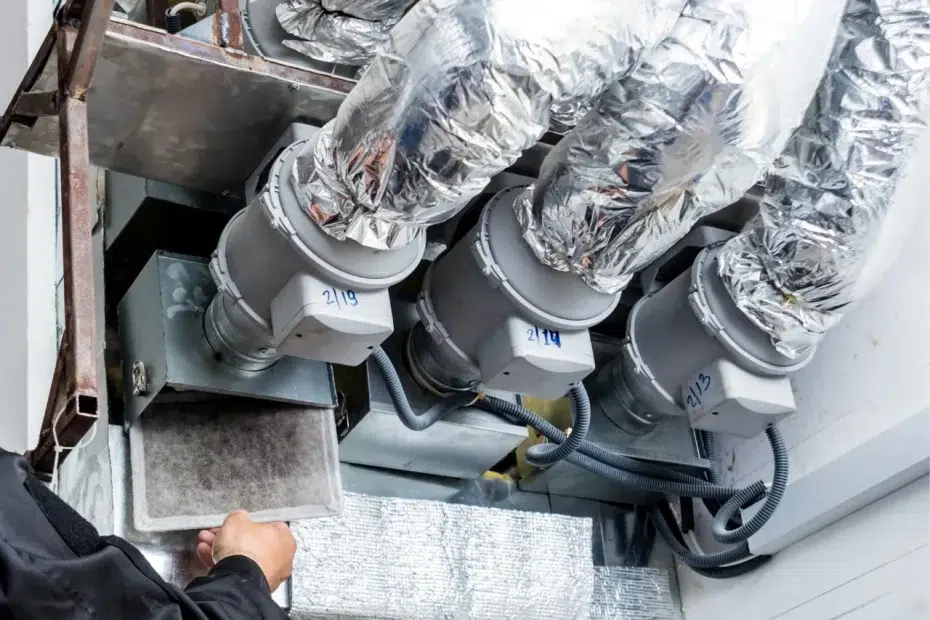
A proper PPM visit checks filters, coils, electrical connections, drainage, refrigerant levels, and overall system performance against manufacturer specifications. Engineers should clean components where needed, test controls respond correctly to setpoints, and look for early signs of wear before they cause a breakdown.
On refrigeration systems and commercial refrigeration equipment, particular attention goes to evaporator coil condition and refrigerant gas charge, since a slow leak can quietly reduce cooling capacity for months. Ask for a written report after every visit stating what was inspected, what was found, and what action is recommended, with clear priority levels attached to each item.
How Often Should Commercial Equipment Be Serviced?
Commercial air conditioning systems typically need servicing every three to six months, depending on usage intensity, occupancy levels, and operating environment. A restaurant kitchen or gym with heavy daily use needs more frequent attention than a modest office running standard hours.
Domestic and light commercial units generally manage on one professional service per year as a baseline, with additional filter cleaning in between. Systems exposed to dust, grease, or coastal air deteriorate faster and justify shorter intervals. Air27 sets service frequency by asset criticality and site conditions rather than applying one blanket schedule across every location.
Which Warning Signs Need Urgent Attention?
A system taking noticeably longer to cool a space, combined with a sudden jump in electricity bills, signals a fault that needs prompt inspection. Strange noises, unpleasant smells, water leaks, or weaker cooling than usual are the other clear indicators that something has gone wrong internally.
None of these symptoms should wait for the next scheduled visit. A blocked filter or restricted outdoor unit often causes the same performance drop as a refrigerant leak, and only a qualified engineer can tell the difference safely. Refrigerant is a sealed-system component. If levels are low, the correct response is a leak search, not a straightforward top-up.
When Should an Older System Be Repaired or Replaced?
Replacement becomes the sensible option once repair costs, energy consumption, and refrigerant availability combine to make an older unit more expensive to keep than to swap out. Systems using refrigerants being phased down under the Kigali Amendment and Montreal Protocol face increasing difficulty sourcing replacement gas, which pushes repair costs upward over time.
Track call-outs and refrigerant top-ups for each significant asset. Repeated reactive repairs on the same unit are a warning sign rather than a maintenance strategy, and a TM44 report will often flag oversized or ageing plant as a candidate for replacement. Bodies like Quidos, an accreditation scheme for energy assessors, maintain the standards TM44 assessors work to when making these recommendations.
How Does Proactive Care Reduce Energy Use and Running Costs?
Regular servicing keeps refrigerant charge correct, coils clean, and controls properly calibrated, all of which directly reduce the energy a system needs to reach its target temperature. A unit straining against a blocked filter or low refrigerant charge draws more power for less cooling, and that inefficiency shows up as higher bills within a single billing cycle.
Beyond cost, a well-maintained system produces fewer greenhouse gases over its working life by avoiding refrigerant leaks and running more efficiently. Air conditioning maintenance London landlords and facilities managers invest in tends to pay for itself through lower energy consumption and fewer emergency call-outs. Consistent air conditioning maintenance London-wide, paired with proper compliance records, protects both the equipment and the budget attached to it.

For further guidance, read “Air Conditioning Maintenance Companies in London” and “Does Air Conditioning Need Servicing” to learn more about choosing providers and keeping your system properly maintained.
Conclusion
Meeting air conditioning maintenance London requirements means treating statutory inspection, F-gas compliance, and planned preventative maintenance as parts of one system rather than separate boxes to tick. Systems over 12kW need TM44 inspections every five years, refrigerant-containing equipment needs certified handling and leak checks, and every visit should generate a record you can produce on demand.
Building owners who keep documentation organised by asset, service equipment according to actual usage and risk, and act on warning signs promptly tend to avoid both enforcement issues and expensive emergency repairs. Air27 continues to see the same pattern across London properties: the sites with the fewest breakdowns are the ones treating compliance and servicing as a single, ongoing plan.


Comments