
Mitsubishi VRF System: City Multi Guide
Choosing a VRF system Mitsubishi solution from Air27 gives you a flexible way to heat and cool multiple areas. Air27 supplies and installs modern VRF air conditioning systems using Mitsubishi Electric’s City Multi range to match output with demand across separate zones.
City Multi VRF systems suit buildings where rooms have different occupancy patterns or thermal loads. You can connect up to 50 indoor units to one outdoor unit, subject to the selected equipment and design requirements, creating a practical platform for offices, hotels and other commercial properties across Europe and the CIS.

How Mitsubishi City Multi Systems Work
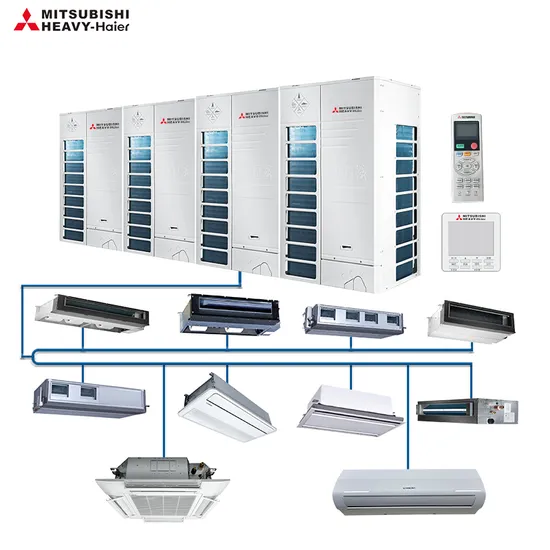
At Air27, our Mitsubishi City Multi systems transfer heating or cooling energy through refrigerant between outdoor units and multiple indoor units. This advanced VRF air conditioning setup delivers independent comfort control, scalable capacity and options for heat pump or heat recovery operation.
The system design also supports energy efficiency through inverter-driven operation, microchannel heat exchangers and control logic that responds to changing demand. You can integrate temperature control with building automation, while separate ventilation equipment handles fresh-air requirements.
How Refrigerant Connects Outdoor and Indoor Units
A VRF air conditioning installation uses an outdoor unit, refrigerant pipework and a network of indoor units. The outdoor unit changes refrigerant pressure and temperature, while each indoor unit uses its heat exchanger to deliver heating or air conditioning to the served space.
Variable refrigerant flow technology modulates the refrigerant volume according to the load in each zone. A lightly occupied room therefore receives less capacity than a busy area, which supports energy savings across the HVAC system.
Mitsubishi Electric describes City Multi systems as providing heating and cooling by recycling refrigerant between the outdoor unit and indoor units, with microchannel heat exchangers helping reduce refrigerant volume within the City Multi range.
How Zone Control Improves Temperature Control
Zone control lets you set conditions for individual rooms or areas, so your temperature control reflects occupancy, orientation and equipment loads. You can schedule meeting rooms, offices or circulation spaces independently through local controllers, central controls or building automation.
Advanced control logic adjusts output as demand changes. Good commissioning remains essential: installers need accurate room data, correctly selected indoor units and balanced controls to prevent one zone’s requirements from driving unnecessary operation elsewhere.
Heat Pump vs. Heat Recovery Operation
A heat pump system serves connected zones in the same operating mode, while a heat recovery system transfers heat between zones that need heating and those that need cooling. This makes simultaneous heating and cooling useful in buildings with varied internal conditions, including high-rise buildings, hotels and medical centres.
The City Multi range includes the R2 Series for heat recovery and the Y Series for heat pump operation. Heat recovery requires the appropriate refrigerant circuit arrangement and a BC controller, which manages distribution between indoor units. Two-pipe heat pump systems and three-pipe systems designed for simultaneous heating and cooling are also recognised configurations in commercial VRF systems described by the UK product guidance.
R2 Series vs. Y Series
The R2 Series suits buildings where different zones need heating and cooling at the same time. The Y Series suits projects where the connected areas operate in a shared heating or cooling mode.
Criterion | R2 Series | Y Series |
System type | Heat recovery | Heat pump |
Simultaneous heating and cooling | Yes | No |
BC controller | Required for heat recovery design | Not used for heat recovery distribution |
Best fit | Varied zone loads | Shared operating mode |
Pipe arrangement | Three-pipe configuration | Two-pipe configuration |
Your design team should confirm pipe lengths, outdoor-unit combinations, indoor-unit selection and control requirements before choosing the series.
Choosing the Right Configuration for Your Building
The right configuration follows your building’s zoning, refrigerant strategy, installation programme and safety assessment. Air27 helps you select the ideal VRF air conditioning setup, whether standard City Multi or hybrid VRF with water distribution.
Your choice should also account for R32 refrigerant, leak detection, plant-space access and the need to reduce your building’s carbon footprint. A qualified designer can match capacity and controls to the building load instead of relying on floor area alone.
When Is Hybrid VRF the Better Choice?
Hybrid VRF is the better choice when you want simultaneous heating and cooling with water distributed to indoor units. HVRF combines refrigerant between the outdoor unit and HBC with water circuits serving the occupied spaces, reducing refrigerant presence indoors.
This configuration can support design and safety objectives where refrigerant volume or occupied-space routing requires careful management. The hybrid VRF arrangement for simultaneous heating and cooling uses a two-pipe system and keeps refrigerant out of occupied indoor spaces.
Which Buildings Suit City Multi?
City Multi suits buildings with multiple zones, variable occupancy and different thermal demands. Air27 installs VRF air conditioning in offices, hotels, hospitality venues, schools, medical centres and high-rise buildings requiring independent comfort control.
You should assess operating hours, room-by-room loads, ceiling voids, façade exposure and ventilation requirements. A City Multi VRF design can serve complex commercial layouts from a coordinated outdoor-unit system, with independent zone control highlighted in this commercial HVAC overview.
What to Consider for Retrofit and Phased Installation
Retrofit projects need a survey of existing pipework, electrical capacity, plant access, structural loading and occupied-space constraints. You should also establish whether the installation can be divided into practical phases, with each phase commissioned and controlled safely before the next begins.
Modular design helps you plan equipment around access routes and future capacity needs. Confirm compatibility before retaining any existing components, since refrigerant, pipe sizing, controls and commissioning requirements must align with the selected City Multi equipment.

For more insights, explore our blogs on VRF System Daikin and VRF Air Conditioning For Home to compare systems and explore residential VRF solutions.
Refrigerant Safety, Leak Detection and Lower-Carbon Design
Refrigerant safety starts with correct charge calculations, pipework installation, pressure testing, commissioning and maintenance. R32 refrigerant requires a project-specific assessment of room volume, system charge, applicable regulations and mitigation measures.
Leak detection should be considered during design, particularly where refrigerant concentration limits affect occupied spaces. City Multi supports pump-down and refrigerant isolation, and its systems can work alongside leak detection equipment for safety and environmental protection as outlined in the UK product information.
An all-electric heat pump approach can reduce reliance on fossil-fuel heating, while heat recovery can reuse heat within the building. You should compare predicted energy use, controls, ventilation demand and maintenance requirements to create a design with a lower carbon footprint.


Comments